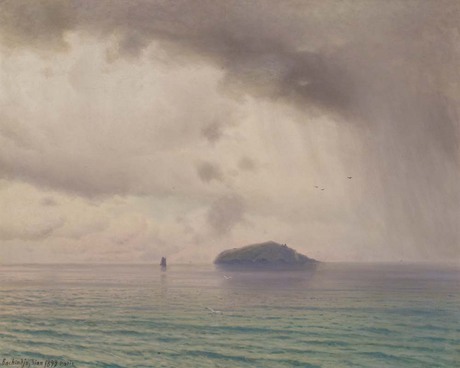
plate no. 7689
Rainy Day in Sevan
Gevorg Bashindzhagian, 1899
study guide
est. 12 hrsapproach — 8 steps
- step 01
Prepare your canvas with a thin, neutral-toned ground.
- step 02
Sketch the basic composition, including the horizon line, island, and cloud formations.
- step 03
Block in the main color areas: the sky, sea, and island, focusing on the overall value structure.
- step 04
Begin blending the colors in the sky to create the soft, diffused light and cloud formations.
- step 05
Work on the sea, adding subtle variations in color and texture to suggest the movement of the water.
- step 06
Develop the island, paying attention to the details of the vegetation and the way it recedes into the distance.
- step 07
Add the small boat and birds, using thin washes of paint.
- step 08
Refine the details and adjust the values to create a cohesive and atmospheric painting.
color palette
primary · Payne's Gray · Titanium White · Yellow Ochre
secondary · Ultramarine Blue · Burnt Umber · Cadmium Yellow Light
Achieve the muted, atmospheric colors by mixing Payne's Gray and Titanium White for the sky and sea. Add small amounts of Yellow Ochre and Burnt Umber to warm the grays and create subtle color variations.
techniques
- ·atmospheric perspective
- ·soft blending
- ·glazing
- ·scumbling
- ·wet-on-wet
common pitfalls
- →Overworking the details, which can detract from the overall atmospheric effect.
- →Using colors that are too bright or saturated, which can make the painting look unnatural.
- →Ignoring the importance of value relationships, which can flatten the image.
- →Not creating enough depth in the painting by failing to use atmospheric perspective effectively.
materials
surface · stretched canvas
required
- ·Stretched canvas (12x16 inches)
- ·Oil paints (Payne's Gray, Titanium White, Yellow Ochre, Ultramarine Blue, Burnt Umber)
- ·Round brushes (sizes 2, 4, 6)
- ·Flat brushes (sizes 4, 8)
- ·Palette
- ·Linseed oil
- ·Odorless mineral spirits
- ·Palette knife
optional
- ·Retouch varnish
- ·Medium (Liquin)
Use high-quality oil paints for best results. A medium can be used to thin the paints and speed up drying time.
tips & new artworks in your inbox
no spam — unsubscribe anytime.
or to save artworks, chat, and track progress
in this vein


