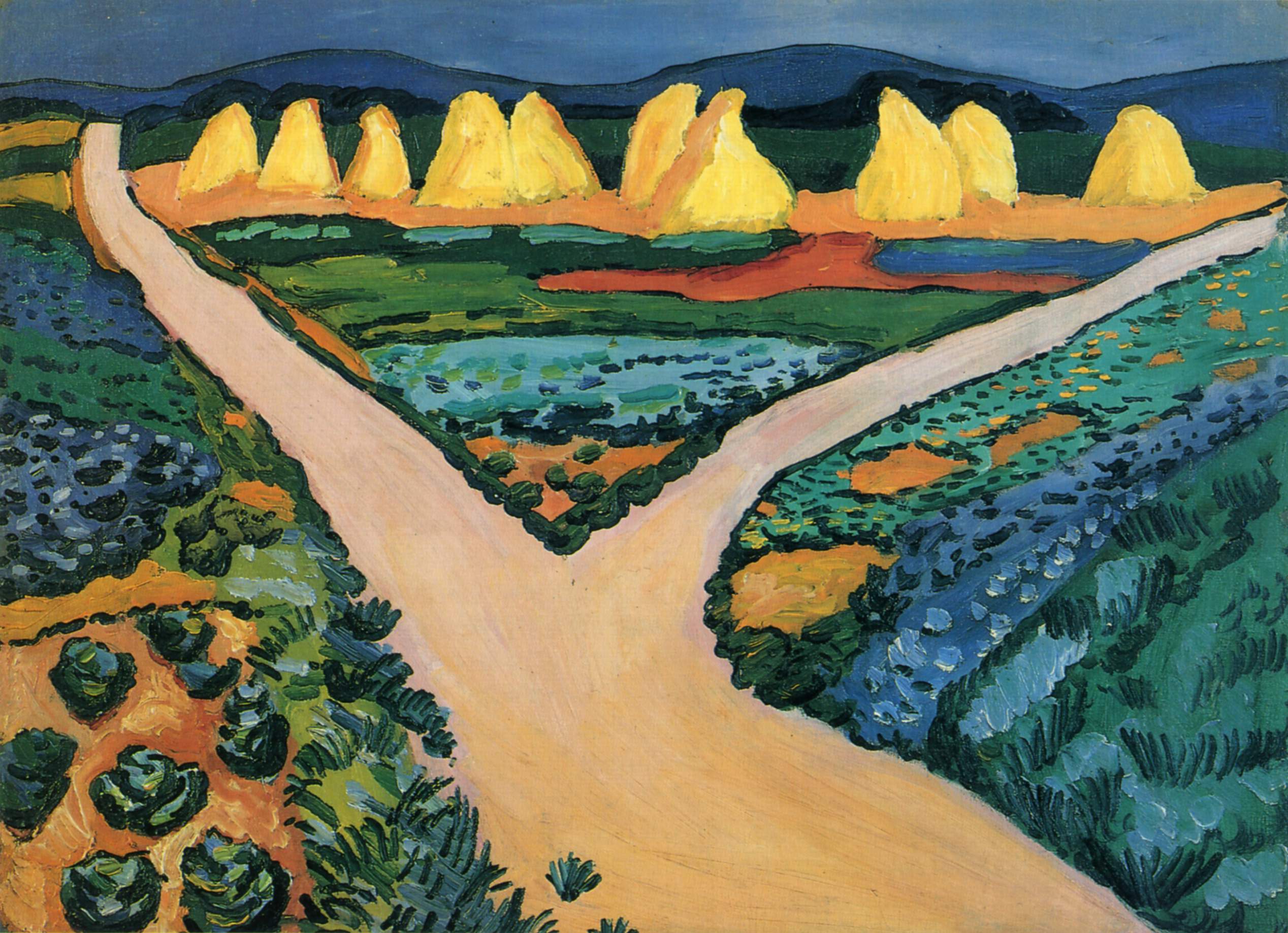
plate no. 6171
Vegetable fields
August Macke, 1911
study guide
est. 8 hrsapproach — 8 steps
- step 01
Sketch the basic composition, focusing on the road's perspective and the placement of the haystacks and fields.
- step 02
Block in the sky and distant hills with broad strokes of blue and dark green.
- step 03
Establish the base colors for the fields, road, and haystacks using simplified color blocks.
- step 04
Add details to the haystacks, varying the yellow tones to suggest light and shadow.
- step 05
Develop the textures of the fields and vegetation with short, directional brushstrokes, mixing greens, blues, and oranges.
- step 06
Refine the road with lighter tones and subtle variations in color to create a sense of depth.
- step 07
Add final details and highlights to the foreground vegetation to enhance the sense of depth and texture.
- step 08
Step back and adjust colors and values as needed to achieve a harmonious composition.
color palette
primary · yellow · green · blue · peach
secondary · orange · dark green · brown · light blue
Mix greens by combining blues and yellows, and create variations by adding small amounts of orange or brown. Achieve the peach color of the road by mixing white, yellow, and a touch of red.
techniques
- ·blocking in
- ·broken color
- ·scumbling
- ·directional brushstrokes
- ·color mixing
common pitfalls
- →Overworking the details and losing the expressive quality of the brushstrokes.
- →Creating muddy colors by over-mixing.
- →Failing to establish a clear sense of depth and perspective.
- →Ignoring the subtle color variations within each area of the painting.
materials
surface · stretched canvas
required
- ·stretched canvas
- ·acrylic or oil paints
- ·flat brushes (various sizes)
- ·palette
- ·palette knife
- ·linseed oil (if using oil paints)
- ·mineral spirits or turpentine (for cleaning brushes)
- ·rags
optional
- ·easel
- ·medium gloss
- ·painting knife
Use a medium-textured canvas to enhance the visibility of the brushstrokes. Acrylics are faster drying and easier to clean up, while oils offer richer colors and blending capabilities.
tips & new artworks in your inbox
no spam — unsubscribe anytime.
or to save artworks, chat, and track progress
in this vein
related artworks

Dolly Sisters
Kees van Dongen

Nude with Loaves
Jean Helion

My Father
Carlos Botelho

Helen
Chronis Botsoglou

The portrait painter in the country
Albin Egger-Lienz

Marketta on Lázeňská street, Prague
Maria Bozoky

Winter at the Entrepotdok, in Amsterdam city
Paul Werner

Old Woman with Masks (Theatre of Masks)
James Ensor