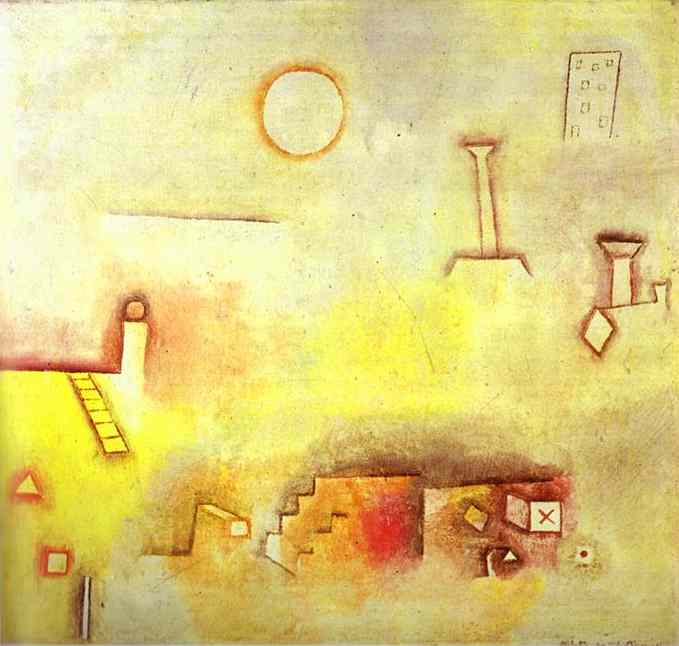
plate no. 4264
Reconstructing
Paul Klee, 1926
recreation guide
Paul Klee’s *Reconstructing* (1926) is a cityscape that exemplifies his mature synthesis of draftsmanship and color theory, developed after his pivotal 1914 trip to Tunisia. Rather than imitating nature directly, Klee sought to create compositions analogous to nature’s formative principles, often dissolving scenery into colored harmonies or grids (Source 7). This work reflects his 'cool romanticism of abstraction,' where the object is never fully abandoned but transformed through a vocabulary of colored rectangles and lines that function like musical notes (Source 6). The painting likely employs his characteristic method of combining linear structure with transparent color layers, treating the canvas as a space for color experiments rather than mere representation.
estimated time
20-30 hours over 5-7 sessions (allowing for drying times between glazes)
materials
7 items
steps
7 in sequence
materials
| item | purpose | modern equivalent |
|---|---|---|
| Oil paints (artist grade) | Primary medium for color application | — |
| Linseed oil | Medium to thin paint and increase oil content for 'fat over lean' layering | Stand oil or refined linseed oil |
| Mineral spirits or turpentine | Solvent for thinning initial layers and cleaning brushes | Odorless mineral spirits |
| Canvas or panel | Support surface | Primed linen or cotton canvas |
| Charcoal or thinned paint | Initial sketching of the composition | Vine charcoal or diluted oil wash |
| Palette knives and rags | Application and removal of paint layers | — |
| Cold wax or resins (optional) | Adjusting translucency and body of paint | Modeling paste or wax medium |
preparation
surface prep
Prepare a rigid support (panel or stretched canvas) with a traditional ground. Klee’s work often involves a synthesis of drawing and color, suggesting a surface that can hold fine linear details while accepting transparent glazes. Ensure the ground is dry and stable to prevent cracking, as oil paint dries by oxidation and requires a stable film (Source 1).
underdrawing
Begin by sketching the subject onto the canvas with charcoal or thinned paint (Source 1). Klee’s style connects drawing and the realm of color; thus, the underdrawing should establish the 'grid' or structural lines that dissolve the scenery into colored harmony (Source 7). Use contour drawing techniques to emphasize the mass and volume of the cityscape elements rather than minor details, focusing on the outlined shapes (Source 8).
underpainting
Apply a monochromatic underpainting (grisaille) to establish values and composition. This technique allows the artist to mentally extract specific colors (like red and yellow) and focus on the structural form before introducing full color (Source 2). This aligns with Klee’s method of building color harmony analogous to musical composition, where the structure precedes the tonal variation (Source 6).
color palette
Pale/Transparent Tones
Thinned oils with linseed oil
General use in this artist's palette; Klee used pale watercolors and limited overlap in earlier works, transitioning to oil glazes
Complementary Pairs
e.g., Blue/Orange, Red/Green
Creating color harmony analogous to musical keys; Klee often used complementary or 'dissonant' colors (Source 6)
Colored Rectangles/Blocks
Opaque or semi-opaque oil
Basic building blocks of the composition, associated with musical notes (Source 6)
composition
The composition should avoid exact bisections of the picture space and ensure the prominent subject is off-center to create balance with smaller satellite elements (Source 5). Klee’s cityscapes often dissolve into a grid, so the arrangement of shapes should feel like a structured harmony rather than a literal depiction (Source 7). Use detailed areas and 'rest' areas to guide the viewer’s eye, ensuring no spaces between objects are identical to create visual interest (Source 5).
step by step
underdrawing→underpainting→first pass→refining→finishing→varnishing
underdrawing
step 01
Sketch the cityscape structure using charcoal or thinned paint, focusing on the grid-like arrangement of buildings and streets.
Tip — Focus on the mass and volume of the structures, not minor details (Source 8).
Contour drawing
underpainting
step 02
Apply a monochromatic layer (grisaille) to establish light and shadow values. Allow this layer to dry completely.
Tip — This prepares the surface for glazing and helps in mentally extracting colors (Source 2).
Grisaille
first pass
step 03
Begin applying color using thin layers of oil mixed with linseed oil. Follow the 'fat over lean' rule: each subsequent layer must contain more oil than the previous one to prevent cracking.
Tip — Ensure proper drying time; oil paint dries by oxidation, not evaporation (Source 1).
Fat over lean
refining
step 04
Use glazing (transparent coats of color) and scumbling (semi-opaque painting) to build up color harmony. Glaze over the dried underpainting to tint the engraving-like structure.
Tip — Glazing adds depth and luminosity; scumbling can create a grey bloom or coldness over darker grounds (Source 2).
Glazing and Scumbling
step 05
Refine the colored rectangles and lines that serve as the basic building blocks of the composition. Adjust translucency and density using cold wax or resins if needed.
Tip — Klee’s style involves combining drawing and color; ensure the linear elements remain distinct yet integrated with the color fields (Source 6).
Layering
finishing
step 06
Review the composition for balance. Ensure the center of interest is clear and that the viewer’s eye is led around all elements before exiting the picture.
Tip — Avoid symmetrical compositions unless intended; use contrast between detail and lack of detail to guide the eye (Source 5).
Compositional Balance
varnishing
step 07
Once the painting is completely dry (up to two weeks), apply a varnish to protect the surface and unify the sheen.
Tip — Varnish can also be mixed with oil for glazing in earlier stages, but final varnishing should be done on a fully cured painting (Source 1, Source 2).
Varnishing
critical techniques
Fat over Lean
A basic rule of oil paint application where each additional layer contains more oil than the layer below to allow proper drying and prevent cracking (Source 1).
Glazing
Applying a transparent coat of color over a dried underpainting to build depth and luminosity, similar to tinting an engraving (Source 2).
Color Harmony as Musical Composition
Klee treated colored rectangles as musical notes, combining them to create harmonies analogous to musical keys, using complementary or dissonant colors (Source 6).
Grid-like Abstraction
Dissolving scenery into a grid to create compositions analogous to nature’s formative principles, rather than imitating nature directly (Source 7).
common pitfalls
- →Applying lean layers over fat layers, which will cause the painting to crack and peel (Source 1).
- →Over-modeling or becoming too tied down to outlines, which can stifle the abstract harmony Klee sought (Source 4).
- →Ignoring the drying time of oil paint, which dries by oxidation and can take up to two weeks to be dry to the touch (Source 1).
- →Creating exact bisections in the composition, which can make the work feel static and unbalanced (Source 5).
what the sources don't tell us
Where the corpus is silent, we say so rather than guess. These are the gaps a complete recreation guide would normally cover that our source passages don't.
- ·The specific color palette used in *Reconstructing* (1926) is not detailed in the sources; Klee’s general use of complementary colors and pale tones is inferred from his broader practice.
- ·The exact layout of the cityscape in *Reconstructing* is not described in the sources; the guide relies on Klee’s general tendency to use grid-like structures and colored rectangles.
- ·Specific preparatory sketches or studies for *Reconstructing* are not mentioned; the underdrawing step is based on general oil painting techniques and Klee’s emphasis on draftsmanship.
grounded in
The technical procedure in this guide traces to the following classical art-instruction texts.
The Practice of Oil Painting↗
- COLOURING A MONOCHROME — applied to Grisaille underpainting, glazing, and scumbling techniques
cross-referenced from
Named facts about this artwork and artist were checked against these reference pages.
Wikipedia: Oil painting↗
- Oil painting — part 2 — applied to Materials, fat over lean rule, drying time, and application methods
Wikipedia: Composition (visual arts)↗
- Composition (visual arts) — part 1 & 6 — applied to Compositional principles, balance, and guiding the viewer’s eye
Wikipedia bio — Paul Klee↗
- Paul Klee — part 4 & 11 — applied to Klee’s artistic style, color theory, grid-like abstraction, and musical analogy
Wikipedia: Contour drawing↗
- Contour drawing — part 1 — applied to Underdrawing technique focusing on mass and volume
Read more about the corpus on the sources page and how the guides are built on the methods page.
tips & new artworks in your inbox
no spam — unsubscribe anytime.
or to save artworks, chat, and track progress
in this vein
related artworks

Dolly Sisters
Kees van Dongen

Nude with Loaves
Jean Helion

My Father
Carlos Botelho

Helen
Chronis Botsoglou

The portrait painter in the country
Albin Egger-Lienz

Marketta on Lázeňská street, Prague
Maria Bozoky

Winter at the Entrepotdok, in Amsterdam city
Paul Werner

Old Woman with Masks (Theatre of Masks)
James Ensor