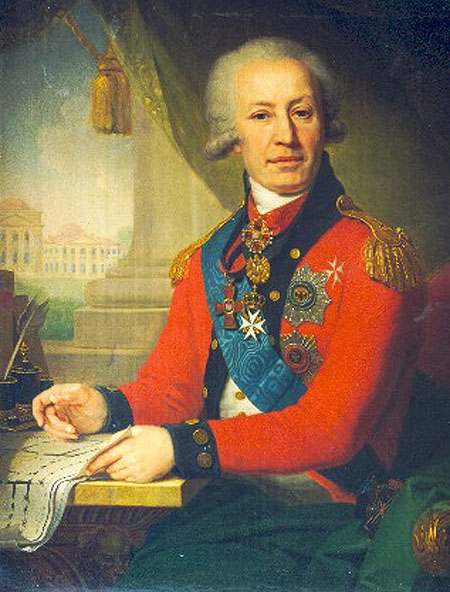
plate no. 7347
Portrait of Alexeï Ivanovitch Vassiliev
Vladimir Borovikovsky, 1800
recreation guide
Vladimir Borovikovsky’s 'Portrait of Alexeï Ivanovitch Vassiliev' (1800) represents the height of his fame as a portraitist in the late 1790s, a period where he embodied the ideal of beauty and subtly conveyed the inner world of his subjects through chamber portraits with limited emotional expression (Source 2). The work is characterized by a fusion of classicist and sentimental styles, typical of his output during this era before his later shift toward more restrained, citizenship-focused depictions in the 1810s (Source 2). As a master craftsman, Borovikovsky’s approach relies on a deep knowledge of oil medium capacities, ensuring that the painting serves as an expression of feeling rather than mere deception (Source 1, Source 6). The portrait likely exhibits the textural mastery for which he was known, particularly in rendering fabrics and accessories, though specific visual details of Vassiliev’s attire are not described in the provided sources (Source 2).
estimated time
40-60 hours over 8-12 sessions
materials
6 items
steps
6 in sequence
materials
| item | purpose | modern equivalent |
|---|---|---|
| Oil paints (artist grade) | Primary medium for painting | — |
| Linseed oil | Medium to thin paint and adjust drying time; essential for 'fat over lean' layering | Refined linseed oil |
| Mineral spirits or turpentine | Solvent for thinning initial layers and cleaning brushes | Odorless mineral spirits |
| Canvas | Support surface | Linen or cotton canvas, primed |
| Charcoal or thinned paint | For initial sketching of the subject onto the canvas | Vine charcoal or raw umber thinned with solvent |
| Varnish (optional for glazing) | To mix with oil for glazing layers, as practiced by old masters | Dammar varnish or painting medium |
preparation
surface prep
The canvas should be prepared with a ground suitable for oil painting. While Borovikovsky’s specific ground recipe is not detailed, traditional oil painting techniques of the period involved preparing a stable surface to prevent cracking. The artist must ensure the ground is dry before beginning, as the 'fat over lean' rule requires each subsequent layer to have more oil content than the previous one to ensure proper drying and stability (Source 7).
underdrawing
Begin by sketching the subject onto the canvas using charcoal or thinned paint. This initial step allows for adjustments to the form and composition before applying opaque paint. Borovikovsky, like many skilled craftsmen of his time, would have relied on a solid drawing foundation to capture the likeness and inner world of the sitter accurately (Source 7, Source 2).
underpainting
Consider using a monochrome underpainting (grisaille) to establish values and forms. This technique involves painting the composition in neutral tones, effectively 'extracting' red and yellow colors to focus on structure. Once dry, this layer serves as a base for glazing and scumbling, a method practiced by old masters to achieve depth and luminosity (Source 5).
color palette
Flesh tones
Lead white, vermilion, yellow ochre, and earth tones
General use in this artist's palette; flesh colors are fixed by the model and require careful modulation to convey the subject's inner life (Source 4, Source 2).
Deep backgrounds
Ultramarine, black, and burnt umber
Creating contrast and depth; Borovikovsky’s chamber portraits often feature restrained backgrounds that focus attention on the sitter (Source 2, Source 5).
Textural highlights
White, lead-tin yellow, and vermilion
Rendering the brilliance of fabrics and accessories, consistent with Borovikovsky’s mastery of texture in ceremonial and chamber portraits (Source 2).
composition
Borovikovsky’s chamber portraits from this period are characterized by a focus on the sitter’s inner world, with limited emotional expression and a restrained appearance (Source 2). The composition likely emphasizes the subject’s dignity and nobility, with the background serving to enhance rather than distract from the figure. Specific compositional details of this portrait are not described in the sources, but the general approach aligns with his practice of fusing classicist and sentimental styles (Source 2).
step by step
underdrawing→underpainting→first pass→refining→finishing→varnishing
underdrawing
step 01
Sketch the subject’s pose and features using charcoal or thinned paint. Focus on capturing the likeness and the subtle emotional expression characteristic of Borovikovsky’s work.
Tip — Ensure the drawing is accurate, as it forms the foundation for the painting. Adjustments can be made easily at this stage.
Initial sketching
underpainting
step 02
Apply a monochrome underpainting (grisaille) to establish values and forms. Use neutral tones to define the light and shadow structure of the portrait.
Tip — Allow this layer to dry completely before proceeding. This step helps in visualizing the final color application without the distraction of hue.
Grisaille
first pass
step 03
Begin applying color using glazing and scumbling techniques. Glaze transparent layers of color over the dry underpainting to build up depth and luminosity. Scumble semi-opaque paint to adjust tones and textures.
Tip — Follow the 'fat over lean' rule: each layer should contain more oil than the previous one to prevent cracking. Use linseed oil as a medium.
Glazing and scumbling
refining
step 04
Refine the flesh tones and facial features to convey the subject’s inner world. Pay attention to the subtle modifications of light and color on the model, using the law of simultaneous contrast to harmonize colors.
Tip — Observe how adjacent colors affect each other. The eye may perceive colors differently due to simultaneous contrast, so adjust hues accordingly.
Color modulation
finishing
step 05
Add final details to the clothing and accessories, emphasizing texture and brilliance. Use small, precise brushstrokes to render the softness of velvet or the sparkle of precious stones, if applicable.
Tip — Borovikovsky’s mastery of texture is evident in his ability to depict various materials convincingly. Focus on the interplay of light and shadow on these surfaces.
Textural rendering
varnishing
step 06
Once the painting is completely dry, apply a varnish to protect the surface and enhance the depth of colors. This step is optional but recommended for long-term preservation.
Tip — Ensure the painting is fully dry to prevent trapping solvents. Use a high-quality varnish suitable for oil paintings.
Varnishing
critical techniques
Glazing and Scumbling
Used to build up color depth and luminosity over a monochrome underpainting. This method allows for subtle adjustments in tone and texture, consistent with old master practices.
Simultaneous Contrast
Applied to harmonize colors in the composition. The artist must perceive how adjacent colors affect each other, adjusting hues to achieve the desired visual effect.
Fat over Lean
A fundamental rule in oil painting where each subsequent layer contains more oil than the previous one. This ensures proper drying and prevents cracking.
common pitfalls
- →Ignoring the 'fat over lean' rule, which can lead to cracking and peeling of the paint layers (Source 7).
- →Over-modeling or being too tied to the outline, which can result in a stiff and unnatural appearance. Borovikovsky’s work suggests a balance between precision and fluidity (Source 1).
- →Failing to account for simultaneous contrast, leading to inaccurate color perception and disharmonious compositions (Source 3).
- →Attempting to deceive the eye with excessive naturalism rather than expressing the emotional idea through painted symbols (Source 6).
what the sources don't tell us
Where the corpus is silent, we say so rather than guess. These are the gaps a complete recreation guide would normally cover that our source passages don't.
- ·Specific visual details of the portrait, such as the exact clothing patterns, jewelry, or background elements, are not described in the sources.
- ·Borovikovsky’s specific palette choices for this particular painting are not documented; the palette list is inferred from general practices of the period and his known style.
- ·The exact dimensions and aspect ratio of the canvas are not provided.
- ·Details about the sitter’s pose and expression are not explicitly described, though general characteristics of Borovikovsky’s portraits are noted.
grounded in
The technical procedure in this guide traces to the following classical art-instruction texts.
The Practice of Oil Painting↗
- ON COPYING — applied to Emphasis on craftsmanship and the importance of understanding the medium’s capacities.
- COLOURING A MONOCHROME — applied to Glazing and scumbling techniques over a grisaille underpainting.
Laws of Contrast of Colour↗
- 315-318 — applied to Techniques for color harmony and perception of light modifications.
The Practice and Science of Drawing↗
- XX MATERIALS — applied to Philosophy of using materials to express feeling rather than mere deception.
cross-referenced from
Named facts about this artwork and artist were checked against these reference pages.
Wikipedia bio — Vladimir Borovikovsky↗
- part 2 — applied to Context on Borovikovsky’s style, period, and mastery of texture.
Wikipedia: Oil painting↗
- part 2 — applied to General oil painting techniques, including 'fat over lean' and material properties.
Read more about the corpus on the sources page and how the guides are built on the methods page.
tips & new artworks in your inbox
no spam — unsubscribe anytime.
or to save artworks, chat, and track progress
in this vein
related artworks

Louis XV, King of France
Charles-Andre van Loo (Carle van Loo)

William James
Joshua Reynolds

Wooded Landscape with Gypsies, Evening
George Lambert

Head of a Scholar
Giovanni Domenico Tiepolo

Gentleman and Wife
William Williams

Portrait of Antoine Watteau
Rosalba Carriera

Portrait of Henriette of France, daughter of Louis XV
Jean-Étienne Liotard

Mr. John Williams
Benjamin West