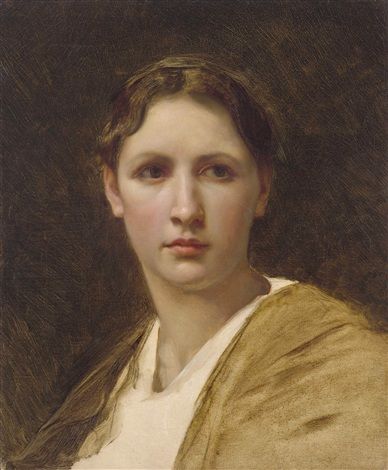
plate no. 6362
Head study
recreation guide
William-Adolphe Bouguereau’s 'Head study' (1898) exemplifies the Academic tradition, prioritizing rigorous anatomical construction and idealized realism. The work is distinctive for its reliance on a meticulous preparatory drawing phase, where structural accuracy is established before any paint is applied, ensuring that the final image possesses a 'vivid manner' of form rather than mere photographic replication (Source 4). The painting process is characterized by a layered approach, utilizing oil’s capacity for rich color and subtle tonal transitions to model the human figure with 'simple treatment' despite its underlying complexity (Source 2). The artist’s method avoids the 'meretricious attempt to deceive the eye' in favor of expressing the emotional significance of the subject through the specific vitality of the oil medium (Source 3).
estimated time
20-30 hours over 5-7 sessions
materials
6 items
steps
7 in sequence
materials
| item | purpose | modern equivalent |
|---|---|---|
| Oil paints (Raw Umber, White) | Initial underpainting and tonal modeling | Raw Umber and Titanium White or Lead White substitute |
| Turpentine | Thinner for initial washes and brush cleaning | Odorless mineral spirits or pure gum turpentine |
| Charcoal | Underdrawing and initial shading | Vine charcoal or compressed charcoal |
| Bread | Erasing charcoal corrections without damaging the ground | Kneaded eraser or soft bread |
| Canvas | Support for the oil painting | Linen or cotton canvas, primed |
| Hand-glass (Mirror) | Comparing the drawing to the sitter from a distance | Small hand mirror |
preparation
surface prep
The canvas should be prepared with a ground suitable for oil painting. While specific priming recipes for this exact work are not detailed in the sources, Bouguereau’s academic practice typically involved a smooth, white or light-toned ground to facilitate the layering of translucent glazes and the visibility of the underdrawing. The surface must be stable enough to withstand the 'dry brush' modeling and charcoal corrections described in the sources (Source 1).
underdrawing
The underdrawing is critical and must be executed in charcoal. The artist should 'draw and then shade in charcoal' to establish the construction and proportions (Source 1). It is essential to 'make all corrections while you can in the charcoal stage' because charcoal offers little resistance to a brush and can be easily removed with bread (Source 1). The drawing should be placed 'on a level with, and as near as possible to, the face' of the sitter to compare it with nature through a hand-glass, ensuring the scale is accurate and avoiding the illusion of incorrect size (Source 1). This stage requires 'minute visual expression' to become instinctive, allowing the artist to focus on larger qualities later (Source 4).
underpainting
The underpainting should be set with 'raw umber, and the softer white, and use turpentine' (Source 1). This initial layer is not intended to complete the study; rather, the artist should paint with the idea of 'going over it at least three or four times' (Source 1). This approach leverages the oil medium’s flexibility and capacity for layers, allowing for the gradual buildup of tone and form without the 'fatal' errors that result from putting down paint with obvious construction mistakes (Source 1).
color palette
Raw Umber
Raw Umber pigment
Initial underpainting and establishing mid-tones
White
White pigment (likely Lead White historically)
Mixing with umber for underpainting and highlighting
Flesh Tones
Complex mixtures adjusted with complements
Modeling the face and hair, avoiding simple black/white shading which shifts hue
Background/Neutral
Neutralized tones
Creating harmony and contrast without distracting from the subject
composition
The composition is a head study, likely slightly smaller than life size, as advised for such studies to maintain proportion accuracy (Source 1). The focus is on the 'external and the apparent'—color, tone, texture, and light and shade—while relying on an internal understanding of the 'bony structure of the skeleton, and the location, attachment and function of the muscles' (Source 2). The arrangement should avoid 'commonplace appearance' in favor of 'artistic accuracy' that conveys the emotional significance of the subject (Source 4).
step by step
underdrawing→underpainting→first pass→refining→finishing→varnishing
underdrawing
step 01
Draw the head in charcoal, ensuring the drawing is slightly smaller than life. Shade in charcoal to establish basic forms.
Tip — Hold your brush against the model’s face to ascertain length and proportions.
Charcoal underdrawing
step 02
Place the drawing alongside the sitter, on a level with the face, and use a hand-glass to compare the drawing with nature from a distance.
Tip — Correct any scale or proportion errors now; charcoal is easily erased with bread.
Mirror comparison
underpainting
step 03
Mix raw umber and white with turpentine. Apply a thin wash to establish the basic tonal values.
Tip — Do not attempt to finish the painting in one go; plan for multiple layers.
Imprimatura/Underpainting
first pass
step 04
Model the forms using a dry brush. Focus on the construction of the head, keeping in mind the underlying anatomy.
Tip — Avoid putting down paint with obvious errors in construction; correct in charcoal first.
Dry brush modeling
refining
step 05
Build up subsequent layers, refining the flesh tones and details. Use color theory to adjust hues without shifting them unintentionally.
Tip — When darkening colors, use complements rather than black to avoid hue shifts.
Layering
finishing
step 06
Finalize the details, ensuring the 'minute visual expression' is achieved. The final image should be a 'painted symbol' true to nature but expressive of the artist’s feeling.
Tip — Remember that art is not a substitute for nature but an expression of feeling.
Academic finish
varnishing
step 07
Apply a varnish to protect the painting and unify the surface sheen.
Tip — Ensure the painting is fully dry before varnishing.
Varnishing
critical techniques
Charcoal Underdrawing
Essential for establishing accurate construction and proportions before paint is applied. Corrections are made with bread, avoiding paint errors.
Layering
The painting is built up over three or four sessions, allowing for gradual refinement and depth.
Color Mixing with Complements
To darken colors without shifting hue, use complementary colors rather than black, which can cause unwanted greenish or bluish shifts.
Anatomical Construction
Understanding the skeleton and muscles is crucial for rendering the human form with success, even if the final image focuses on surface effects.
common pitfalls
- →Putting down paint with obvious errors in construction or drawing, which is 'fatal to lucidity' (Source 1).
- →Attempting to complete the study in one painting session, which does not allow for the necessary layering and refinement (Source 1).
- →Using black to darken colors, which can cause hue shifts (e.g., yellows shifting toward green) (Source 8).
- →Focusing solely on photographic accuracy rather than 'artistic accuracy' that conveys emotional significance (Source 4).
- →Losing sight of the medium’s vitality, resulting in a 'meretricious attempt to deceive the eye' rather than a fine picture (Source 3).
what the sources don't tell us
Where the corpus is silent, we say so rather than guess. These are the gaps a complete recreation guide would normally cover that our source passages don't.
- ·Specific pigments used by Bouguereau for flesh tones beyond the initial umber/white underpainting.
- ·Exact varnish recipe or type used by the artist.
- ·Specific lighting setup used for the model, though general advice on lighting is given.
- ·Detailed breakdown of the 'softer white' mentioned in Source 1.
grounded in
The technical procedure in this guide traces to the following classical art-instruction texts.
The Practice of Oil Painting↗
- PAINTING FROM LIFE — applied to Underdrawing, underpainting, and layering techniques
The Human Figure↗
- DRAWING THE HUMAN FIGURE — applied to Anatomical construction and understanding of form
The Practice and Science of Drawing↗
- XX MATERIALS — applied to Philosophy of medium and artistic accuracy
- FROM A STUDY BY BOTTICELLI — applied to Importance of minute visual expression and artistic accuracy
cross-referenced from
Named facts about this artwork and artist were checked against these reference pages.
Wikipedia: Color theory↗
- Color theory — part 6 — applied to Color mixing and avoiding hue shifts
Wikipedia: Oil painting↗
- Oil painting — part 1 — applied to General oil painting techniques and materials
Read more about the corpus on the sources page and how the guides are built on the methods page.
tips & new artworks in your inbox
no spam — unsubscribe anytime.
or to save artworks, chat, and track progress
in this vein


