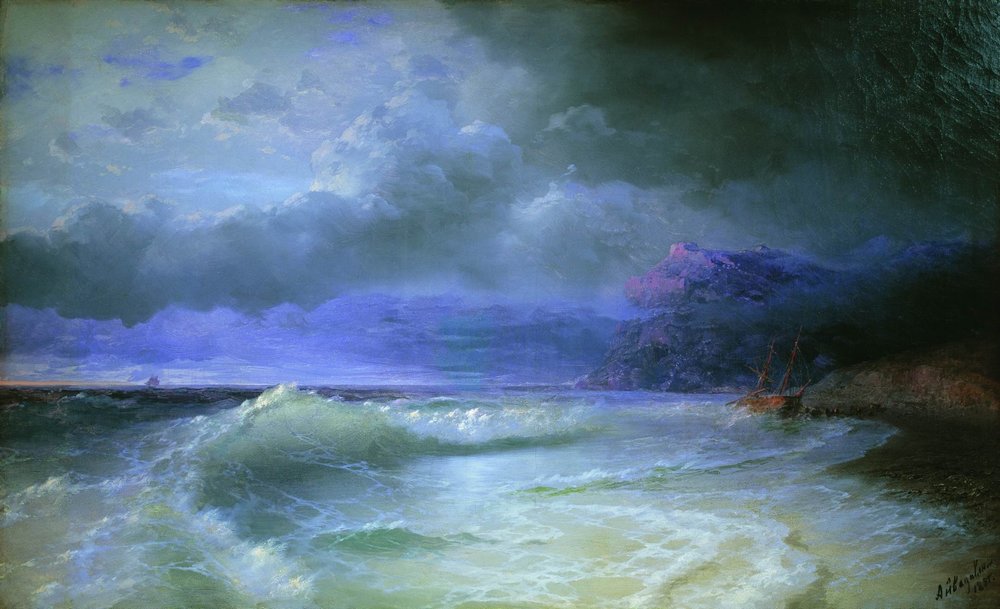
plate no. 4493
Wave
Ivan Aivazovsky, 1895
recreation guide
Ivan Aivazovsky’s 'Wave' (1895) represents the culmination of his lifelong dedication to marine painting, a genre in which he is considered one of the greatest masters (Source 5). By 1895, Aivazovsky was in the final decade of his life, a period characterized by a distinct stylistic shift toward 'silver-toned seascapes' and delicate colors, moving away from the 'fantastic color' of his earlier Romantic works (Source 3). This late period work likely exhibits the 'blue marines' aesthetic noted in his contemporaneous pieces like 'The Bay of Naples in Early Morning' (1897), emphasizing atmospheric light and the romantic struggle between man and the elements (Source 3). The painting reflects his highly academic yet deeply Romantic style, which remained faithful to Romanticism even as Russian art moved toward Realism (Source 3).
estimated time
20-30 hours over 5-7 sessions
materials
4 items
steps
5 in sequence
materials
| item | purpose | modern equivalent |
|---|---|---|
| Oil paints (Titanium White, Ultramarine Blue, Cadmium Yellow, Burnt Sienna, Ivory Black) | To achieve the silver-toned, delicate color palette characteristic of Aivazovsky's late period. | — |
| Linseed oil or Oil of Copavia | Medium for glazing and scumbling, consistent with historical oil painting practices described in period texts. | Stand oil or Walnut oil for slower drying |
| Canvas (primed) | Support for the oil medium. | — |
| Soft charcoal or graphite | For initial contour drawing and underdrawing. | — |
preparation
surface prep
Aivazovsky was a prolific artist who created around 6,000 paintings, suggesting a standardized and efficient preparation method (Source 5). While specific priming recipes for this exact 1895 work are not detailed in the sources, standard academic practice of the time involved a white or light-toned ground to facilitate the luminous effects required for his 'silver-toned' late style (Source 3). The surface should be smooth to allow for the delicate glazing techniques associated with his later work.
underdrawing
Aivazovsky’s style is described as 'highly academic' (Source 3). Academic training emphasizes strong foundational drawing. The underdrawing should focus on contour lines that emphasize the mass and volume of the waves and any debris, rather than minor details, consistent with the principles of contour drawing which convey three-dimensional perspective and form (Source 7). The lines should be light and flexible, allowing for the fluid, organic shapes of the sea.
underpainting
A monochrome underpainting (grisaille) is recommended to establish values before applying color. This aligns with historical oil painting practices where artists would 'mentally extract' colors to focus on form and light (Source 8). For a 'silver-toned' seascape, a cool grey or blue-grey grisaille would be appropriate to establish the luminous quality of the water and sky. This layer should be allowed to dry completely before glazing.
color palette
Silver-Grey
White, Ultramarine Blue, and a touch of Black or Burnt Sienna
Dominant tone for the sea and sky in late-period 'silver-toned' works (Source 3).
Pale Blue
Ultramarine Blue and White
Highlights and atmospheric perspective in the water, consistent with 'blue marines' (Source 3).
Warm Yellow/Orange
Cadmium Yellow and Burnt Sienna
Subtle glazes to suggest sunlight or moonlight, recalling the 'warm tones' that reduce menacing overtones in his earlier work like 'The Ninth Wave' (Source 1), though used more delicately in 1895.
Deep Blue/Black
Ultramarine Blue and Ivory Black
Shadows and depth in the troughs of the waves, providing contrast to the silver highlights.
composition
Aivazovsky’s compositions are characterized by epic and romantic themes, often depicting the 'romantic struggle between man and the elements' (Source 3). While specific compositional details of 'Wave' (1895) are not described in the sources, his general practice involves dynamic arrangements that emphasize the power and beauty of nature (Source 1). The composition likely uses line and shape to guide the eye through the movement of the water, creating a sense of depth and space (Source 2). The scale is likely large, as his later works were 'usually done on a larger scale' (Source 3).
step by step
underdrawing→underpainting→first pass→refining→finishing
underdrawing
step 01
Sketch the main forms of the waves and any figures or debris using light contour lines. Focus on the mass and volume of the water rather than fine details.
Tip — Ensure lines suggest three-dimensional perspective and depth (Source 7).
Contour Drawing
underpainting
step 02
Apply a monochrome grisaille layer using cool greys and blues to establish the value structure of the painting. This helps in mentally extracting colors to focus on form (Source 8).
Tip — Allow this layer to dry completely before proceeding.
Grisaille
first pass
step 03
Begin applying thin glazes of color over the dry grisaille. Use the 'silver-toned' palette characteristic of his late period (Source 3).
Tip — Glazing is a transparent coat of color that allows the underlying painting to show through (Source 8).
Glazing
refining
step 04
Build up the luminosity of the water and sky using scumbling (semi-opaque painting) to create delicate textures and light effects.
Tip — Scumbling over a darker ground can create a 'grey bloom' or coldness, useful for atmospheric effects (Source 8).
Scumbling
finishing
step 05
Add final highlights and details, ensuring the balance between the destructiveness and beauty of nature is maintained, a hallmark of Aivazovsky’s work (Source 1).
Tip — Keep the colors delicate and avoid the 'fantastic color' of his earlier years (Source 3).
Detailing
critical techniques
Glazing
A transparent coat of color applied over a dry underpainting to build luminosity and depth. This was a common practice among old masters and is essential for achieving the delicate, luminous effects in Aivazovsky’s late seascapes (Source 8).
Scumbling
A semi-opaque painting technique used to create texture and light effects, particularly useful for the 'silver-toned' and atmospheric qualities of his later work (Source 8).
Contour Drawing
Used in the underdrawing phase to emphasize the mass and volume of the waves, conveying three-dimensional perspective and form (Source 7).
common pitfalls
- →Using overly saturated or 'fantastic' colors, which are characteristic of Aivazovsky’s earlier works but not his late 'silver-toned' period (Source 3).
- →Focusing too much on minor details in the underdrawing, rather than the mass and volume of the forms (Source 7).
- →Applying glazes before the underpainting is completely dry, which can muddy the colors and ruin the luminous effect (Source 8).
- →Ignoring the academic foundation of his style, leading to a lack of structural integrity in the waves (Source 3).
what the sources don't tell us
Where the corpus is silent, we say so rather than guess. These are the gaps a complete recreation guide would normally cover that our source passages don't.
- ·Specific brush types or sizes used by Aivazovsky for 'Wave' (1895) are not mentioned in the sources.
- ·The exact dimensions of the painting are not provided, though his later works were 'usually done on a larger scale' (Source 3).
- ·Specific details of the subject matter (e.g., presence of figures, specific type of wave) are not described in the sources, so the recreation must rely on general knowledge of his 'blue marines' and 'silver-toned' style.
- ·The specific varnish or medium mixture Aivazovsky used in 1895 is not detailed, though oil of copavia is mentioned as a historical medium (Source 8).
grounded in
The technical procedure in this guide traces to the following classical art-instruction texts.
The Practice of Oil Painting — COLOURING A MONOCHROME↗
- Glazing and Scumbling — applied to Underpainting, Step 3, Step 4, Critical Techniques
cross-referenced from
Named facts about this artwork and artist were checked against these reference pages.
Wikipedia bio — Ivan Aivazovsky — part 3↗
- Style and Themes — applied to Overview, Color Palette, Composition Notes, Step 5
Wikipedia: The Ninth Wave↗
- Description — applied to Overview, Step 5
Wikipedia: Contour drawing↗
- Technique — applied to Underdrawing, Step 1, Critical Techniques
Wikipedia bio — Ivan Aivazovsky — part 1↗
- Career — applied to Overview, Surface Prep
Wikipedia: Composition (visual arts)↗
- Elements of Design — applied to Composition Notes
Read more about the corpus on the sources page and how the guides are built on the methods page.
tips & new artworks in your inbox
no spam — unsubscribe anytime.
or to save artworks, chat, and track progress
in this vein
related artworks

Romantic Landscape
Karl Lessing

Self-portrait with his brother Francesco
Giuseppe Tominz

Oenone Refuse de Secourir Pâris au Siège de Troie
Léon Cogniet

Duke of Alba
Francisco Goya

Blick Aus Dem Wald Ins Tal
Andreas Achenbach

Young Girl Fixing Her Hair
Sophie Gengembre Anderson

The Plough Inn
William Shayer

Hudson River Landscape
Johann Hermann Carmiencke