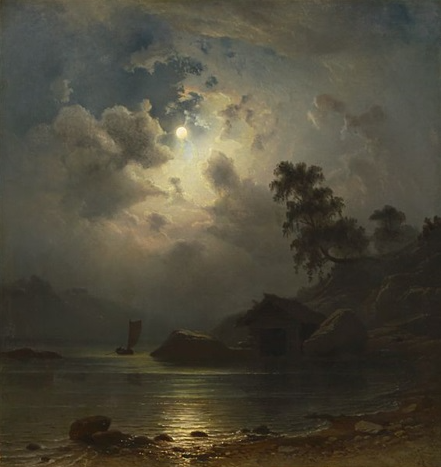
plate no. 0731
Moonlight
study guide
est. 12 hrsapproach — 8 steps
- step 01
Sketch the basic composition, focusing on the placement of the horizon line, moon, and major landforms.
- step 02
Establish the dark underpainting with a mix of dark blues, browns, and greens.
- step 03
Begin layering in the sky, starting with the darkest areas and gradually adding lighter tones around the moon.
- step 04
Paint the water, capturing the reflections of the moon and the surrounding landscape.
- step 05
Add details to the landforms, including rocks, trees, and the small structure.
- step 06
Refine the highlights and shadows to create depth and dimension.
- step 07
Add the boat in the distance, paying attention to its scale and placement.
- step 08
Make final adjustments to the overall composition and color balance.
color palette
primary · ultramarine blue · raw umber · titanium white · yellow ochre
secondary · burnt sienna · ivory black · cadmium yellow light
Achieve the subtle gradations in the sky by gradually mixing white into the blues and browns. Use yellow ochre and cadmium yellow light to create the warm glow around the moon. Mix dark blues and browns for the shadows in the landforms.
techniques
- ·glazing
- ·scumbling
- ·dry brushing
- ·blending
- ·layering
common pitfalls
- →Overworking the details in the foreground.
- →Failing to create a convincing sense of atmospheric perspective.
- →Making the moon too bright and overpowering.
- →Not achieving smooth transitions in the sky.
materials
surface · stretched canvas
required
- ·stretched canvas 18x24
- ·ultramarine blue oil paint
- ·raw umber oil paint
- ·titanium white oil paint
- ·yellow ochre oil paint
- ·round brushes (sizes 2, 4, 6)
- ·flat brushes (sizes 4, 8)
- ·linseed oil
optional
- ·palette knife
- ·painting medium
- ·varnish
Use high-quality oil paints for best results. Consider using a medium to improve the flow and blending of the paints.
tips & new artworks in your inbox
no spam — unsubscribe anytime.
or to save artworks, chat, and track progress
in this vein
related artworks

Romantic Landscape
Karl Lessing

Self-portrait with his brother Francesco
Giuseppe Tominz

Oenone Refuse de Secourir Pâris au Siège de Troie
Léon Cogniet

Duke of Alba
Francisco Goya

Blick Aus Dem Wald Ins Tal
Andreas Achenbach

Young Girl Fixing Her Hair
Sophie Gengembre Anderson

The Plough Inn
William Shayer

Hudson River Landscape
Johann Hermann Carmiencke