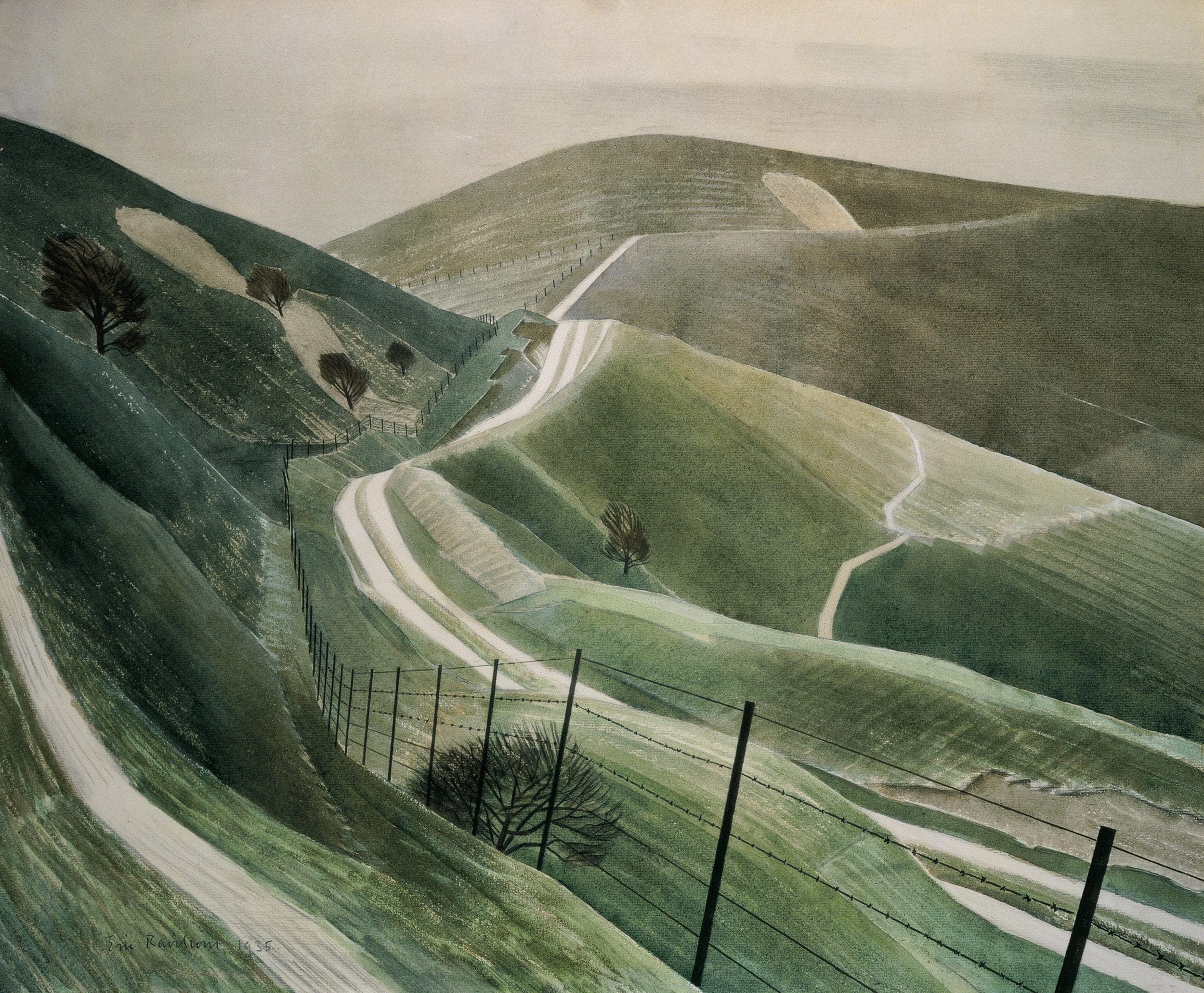
plate no. 5609
Chalk Paths
Eric Ravilious, 1935
study guide
est. 8 hrsapproach — 8 steps
- step 01
Lightly sketch the basic shapes of the hills and paths, paying attention to their relative sizes and positions.
- step 02
Establish the horizon line and the overall composition.
- step 03
Apply a thin wash of light gray or beige to the sky area.
- step 04
Begin layering the greens on the hills, starting with the darkest values and gradually adding lighter tones.
- step 05
Use dry brush techniques to create texture on the hillsides.
- step 06
Paint the paths with a light beige or off-white, adding subtle shadows to define their form.
- step 07
Add the details of the trees and fence, using a fine brush for precision.
- step 08
Refine the details and adjust the values as needed to create a sense of depth and atmosphere.
color palette
primary · sap green · raw umber · titanium white
secondary · payne's gray · yellow ochre
Mix various shades of green by combining sap green, raw umber, and titanium white. Use payne's gray to darken the greens and create shadows. Add a touch of yellow ochre to warm up some of the green tones.
techniques
- ·dry brush
- ·atmospheric perspective
- ·linear perspective
- ·glazing
common pitfalls
- →Overworking the details and losing the overall sense of atmosphere.
- →Creating too much contrast and flattening the image.
- →Not paying attention to the subtle tonal variations in the hills.
- →Making the paths too bright and distracting from the rest of the painting.
materials
surface · watercolor paper 140lb
required
- ·watercolor paper 140lb
- ·watercolor paints
- ·#2 round brush
- ·#6 flat brush
- ·palette
- ·water container
- ·paper towels
optional
- ·masking fluid
- ·palette knife
- ·kneaded eraser
Use high-quality watercolor paints for best results. Experiment with different brushes to find the ones that work best for you.
tips & new artworks in your inbox
no spam — unsubscribe anytime.
or to save artworks, chat, and track progress


