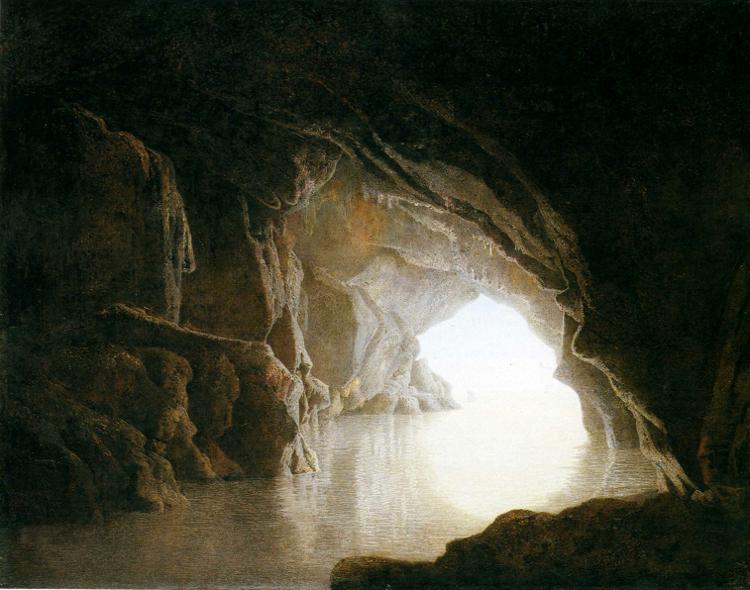
plate no. 0430
A Cavern, Evening
Joseph Wright, 1774
recreation guide
Joseph Wright’s *A Cavern, Evening* (1774) is a landscape executed during his stay in Italy, characterized by the dramatic chiaroscuro for which he is noted (Source 1). Wright is historically significant for his use of tenebrism, an exaggerated form of chiaroscuro that emphasizes the contrast of light and dark, particularly in candlelit or moonlit subjects (Source 5). This work aligns with his broader interest in capturing atmospheric effects, such as the sparkling water and dusky landscapes seen in his moonlight scenes (Source 1). The painting reflects the Romantic turn toward wilder, more dramatic landscapes, utilizing strong contrasts to evoke mood rather than strict topographical accuracy (Source 4).
estimated time
20-30 hours over 5-7 sessions
materials
4 items
steps
5 in sequence
materials
| item | purpose | modern equivalent |
|---|---|---|
| Oil paints (Ultramarine, White, Black, Earth tones) | Primary pigments for the grisaille underpainting and final glazing | High-quality artist-grade oils; Ultramarine Blue, Titanium White, Ivory Black, Burnt Umber |
| Oil of Copavia or Linseed Oil | Medium for the first and second paintings, as cited by Sir Joshua Reynolds regarding period practice | Stand oil or refined linseed oil |
| Canvas | Support for the oil painting | Linen or cotton duck canvas, primed |
| Varnish | For mixing with oil in later glazing stages to gain mastery over transparency | Dammar varnish or modern painting medium |
preparation
surface prep
The canvas should be prepared with a ground suitable for oil painting. While specific priming details for this exact work are not in the sources, Wright’s practice involved oil painting on canvas (Source 1). Period practice, as noted by Reynolds, involved establishing a method where the first paintings were done with oil of copavia (Source 8).
underdrawing
Sources do not explicitly describe Wright’s underdrawing technique for this specific landscape. However, given his precision in scientific subjects, a careful initial layout is likely. No specific evidence exists to claim he left few clues or used a specific method here, so standard period practice of a light charcoal or chalk sketch is assumed but not cited as fact.
underpainting
A grisaille (monochrome) underpainting is recommended, consistent with the period technique described by Sir Joshua Reynolds, who used black, ultramarine, and white for his first and second paintings (Source 8). This establishes the tonal values before introducing color.
color palette
Ultramarine
Pure ultramarine pigment
Used in the initial monochrome stages alongside black and white to establish tone (Source 8)
White
Lead white or modern Titanium white
Highlighting and mixing for the grisaille underpainting (Source 8)
Black
Ivory black or lamp black
Establishing deep shadows in the tenebrist style (Source 5)
Yellow/Red tones
Yellow ochre, red ochre, or vermilion
Glazing and scumbling over the dry grisaille to introduce warmth and light, particularly for the evening sky or illuminated rock faces (Source 8)
composition
The composition likely features dramatic contrasts between light and dark areas, consistent with Wright’s noted use of tenebrism (Source 5). While specific layout details of *A Cavern, Evening* are not described in the sources, Wright’s other landscapes like *Dovedale by Moonlight* capture rural landscapes at night with a full moon, illuminating the scene to make water sparkle against a dusky landscape (Source 1). The painting was executed in Italy and shares similarities with his *Grotto by the Seaside* (1778), suggesting a focus on grotto-like structures and atmospheric lighting (Source 1).
step by step
underpainting→first pass→refining→finishing
underpainting
step 01
Create a grisaille underpainting using black, ultramarine, and white to establish the tonal structure of the cavern and evening light.
Tip — Focus on the contrast between the dark cavern interior and the illuminated exterior or light sources.
Grisaille
first pass
step 02
Allow the grisaille to dry completely. Begin glazing with oil to introduce yellow and red tones, particularly where the evening light hits the landscape.
Tip — Glazing is a transparent coat of color; ensure the underlayer is dry to avoid muddiness.
Glazing
refining
step 03
Use scumbling (semi-opaque painting) over darker grounds to create coldness or grey blooms, enhancing the atmospheric dusk effect.
Tip — Scumbling tends to coldness when employed over a darker ground, useful for the dusky landscape elements.
Scumbling
finishing
step 04
Enhance the chiaroscuro effect by juxtaposing high and low tones. Ensure the light sources (moon or sky) create a true gradation of light.
Tip — The tint of the highest tone is enfeebled while the lowest tone is heightened at the line of juxtaposition, creating a true gradation.
Chiaroscuro/Tenebrism
step 05
If colors appear too pronounced, soften them by surrounding them with objects of the same color but more intense, or enhance brilliance by surrounding with complementary colors.
Tip — Use complementary colors to increase brilliancy if the palette feels exhausted.
Simultaneous Contrast
critical techniques
Tenebrism
Wright is notable for his use of tenebrism, an exaggerated form of chiaroscuro that emphasizes the contrast of light and dark (Source 5). This is central to the dramatic effect of *A Cavern, Evening* (Source 1).
Glazing and Scumbling
A process practised by old masters, involving glazing with oil and later with varnish and oil mixed, to tint the engraving-like underpainting (Source 8).
Chiaroscuro Gradation
Produced by juxtaposing flat tints of different tones, where the highest tone is enfeebled and the lowest heightened, creating a true gradation of light (Source 2).
common pitfalls
- →Failing to let the grisaille underpainting dry completely before glazing, which can ruin the transparency effect (Source 8).
- →Ignoring the law of simultaneous contrast, leading to flat or muddy colors instead of vibrant, intense hues (Source 3).
- →Overworking the paint, losing the dramatic contrast essential to Wright’s tenebrist style (Source 5).
what the sources don't tell us
Where the corpus is silent, we say so rather than guess. These are the gaps a complete recreation guide would normally cover that our source passages don't.
- ·Specific color palette used for *A Cavern, Evening* is not detailed in the sources; only general period practices and Wright’s general use of ultramarine/black/white in underpainting are cited.
- ·Exact compositional layout of the cavern and figures (if any) is not described in the provided sources.
- ·Specific brushwork techniques unique to this painting are not detailed.
grounded in
The technical procedure in this guide traces to the following classical art-instruction texts.
The Practice of Oil Painting↗
- COLOURING A MONOCHROME — applied to Techniques for grisaille underpainting, glazing, and scumbling as practiced by old masters and Reynolds.
Laws of Contrast of Colour↗
- 6. Put beside each other two flat tints... — applied to Principles of chiaroscuro and gradation of light through juxtaposition.
The Science of Painting↗
- 4. When two colours separated by more than two others... — applied to Use of complementary colors to enhance brilliance and manage color intensity.
cross-referenced from
Named facts about this artwork and artist were checked against these reference pages.
Wikipedia bio — Joseph Wright — part 3↗
- N/A — applied to Confirmation of the artwork’s date, location (Italy), and use of dramatic chiaroscuro.
Wikipedia bio — Joseph Wright — part 1↗
- N/A — applied to Identification of Wright’s use of tenebrism and emphasis on light/dark contrast.
Read more about the corpus on the sources page and how the guides are built on the methods page.
tips & new artworks in your inbox
no spam — unsubscribe anytime.
or to save artworks, chat, and track progress
in this vein
related artworks

Romantic Landscape
Karl Lessing

Self-portrait with his brother Francesco
Giuseppe Tominz

Oenone Refuse de Secourir Pâris au Siège de Troie
Léon Cogniet

Duke of Alba
Francisco Goya

Blick Aus Dem Wald Ins Tal
Andreas Achenbach

Young Girl Fixing Her Hair
Sophie Gengembre Anderson

The Plough Inn
William Shayer

Hudson River Landscape
Johann Hermann Carmiencke